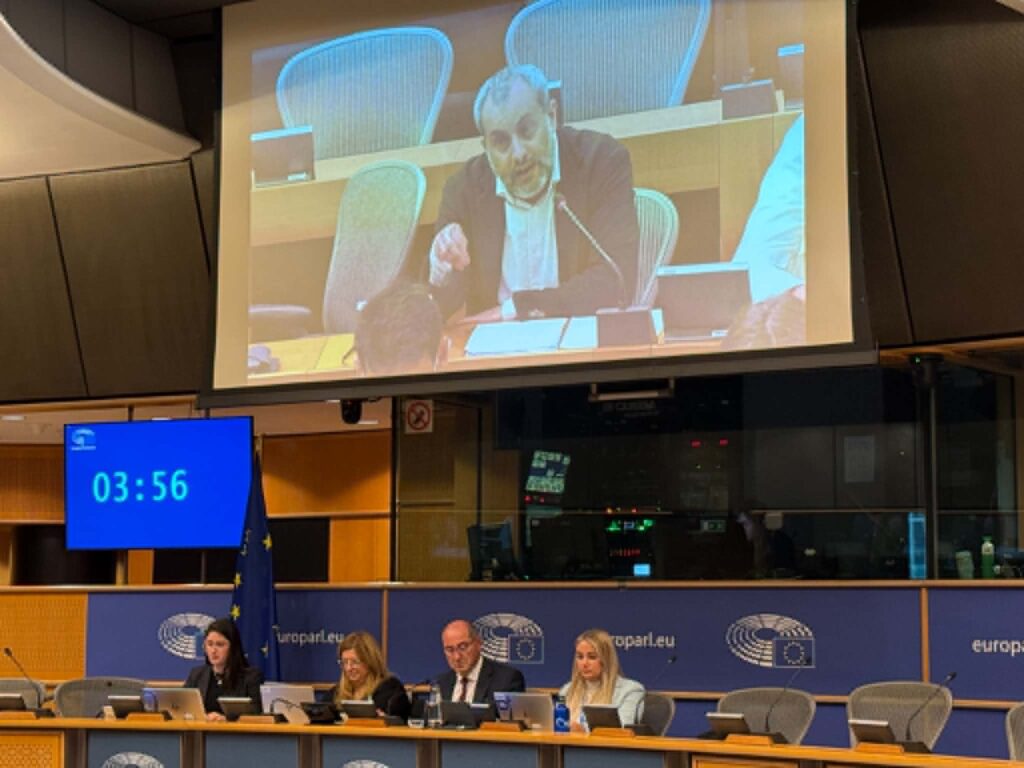

On 10 March the European Parliament adopted with a large majority the INI-report “Copyright and generative artificial intelligence – opportunities and challenges” as approved by the JURI Committee earlier this year.
The report demonstrates a good understanding of the issues at hand and provides a strong but balanced signal to the Commission that copyright dependent sectors require additional action to guarantee that their contribution to the development of AI results in a sharing of added value.
The report recognises the key role our creative and cultural sector plays in the EU and the great diversity in contractual practices that exists in our sector. It condemns the widespread violation of copyright rules by GenAI providers and acknowledges that current copyright law is insufficient to address the challenge of licensing copyrighted material for GenAI.
With this in mind, it calls on the Commission to facilitate a working licensing market that ensures the fair remuneration of rights holders. And in this regard, Parliament expresses itself particularly positively regarding collective management and sends a clear signal to the Commission through a multitude of references that collective management of rights is part of the solution.
However, that role remains limited to being “voluntary”. AEPO-ARTIS remains critical of the fact that a presumption of collective management – as included in Paragraph 6 for journalists – was not granted to performers.
It should be noted here that the notion of “voluntary” primarily refers to the choice not to opt for a levy system under which rights holders would be obliged to grant a license whose price is determined by the government. The voluntary nature lies primarily in the freedom to choose whether or not to offer a license and to determine the price oneself. This could just as easily occur within a system where collective management would be mandatory for certain categories of rights holders—such as journalists and performers. In that case, the mandatory nature would safeguard the freedom to determine the price oneself (as a collective) rather than jeopardise it.
The report also instructs the Commission to examine whether there is a possible solution for the immediate, fair and proportionate remuneration for past uses of copyright-protected works by providers of general-purpose AI models.
Furthermore, the resolution places strong emphasis on transparency. It calls for the strengthening of the transparency obligations for AI developers and proposes the establishment of a rebuttable presumption of use where full transparency obligations have not been fully complied with. It should be noted here that in France, the Conseil d’État expressed a positive opinion last week regarding the Senate’s proposal to introduce such a presumption.
Finally, the issues surrounding digital avatars are also mentioned by the report that instructs the Commission to investigate measures to protect artists against the dissemination of manipulated and AI-generated digital image, audio or video content, imitating their personal characteristics without consent.
You can read the full resolution following this link. While the resolution has no legislative force whatsoever, the Commission is nevertheless obliged to respond to it. In this way, Parliamentary resolutions are of great value for adjusting the Commission’s work plan. If the Commission does not wish to act on the matters raised by Parliament, it will have to provide sound reasons for this.
AEPO-ARTIS has thanked rapporteur Axel Voss (EPP) and his shadow rapporteurs for the enormous work put into getting this balanced text adopted by the Parliament.