
Brussels, 5 May 2026
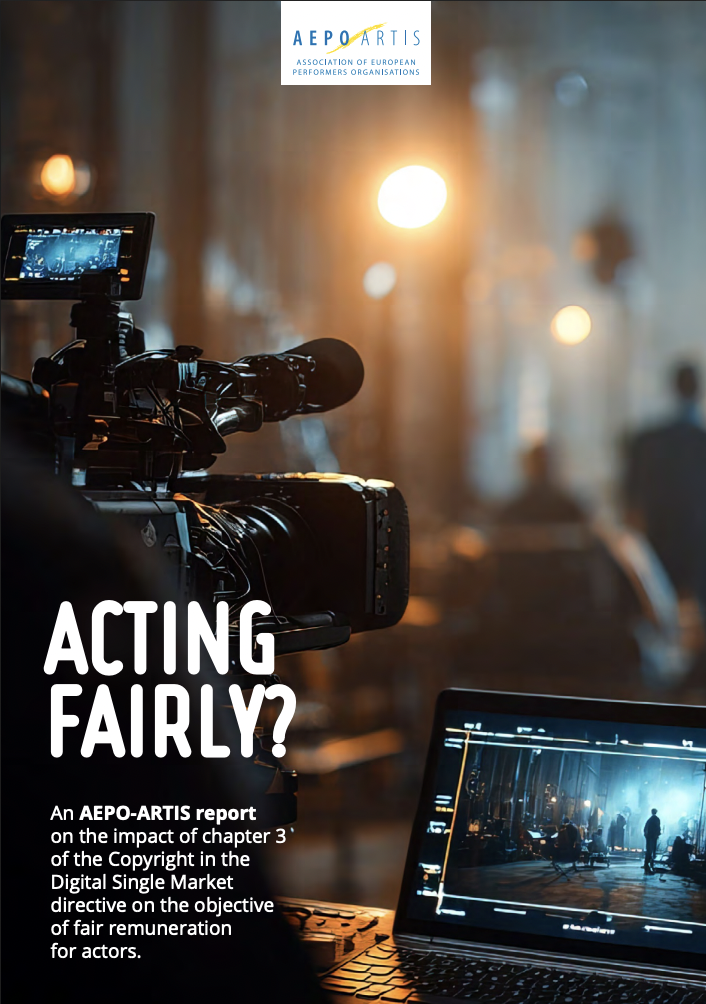
AEPO-ARTIS announces the publication of “Acting Fairly?”, a new report assessing the impact of Chapter 3 of the Copyright in the Digital Single Market (CDSM) Directive on the fair remuneration of actors. The report is based on a survey completed by 2,382 professional actors across 11 EU Member States, making it the most extensive analysis of contractual practices affecting actors since the entry into force of the CDSM Directive.
When the CDSM Directive was adopted in 2019, it recognised that performers are often in a weaker contractual position when they transfer or license their rights. It therefore introduced a specific chapter on fair remuneration, including the principle that performers are entitled to “appropriate and proportionate remuneration”, as well as additional rights to transparency, contract adjustment, alternative dispute resolution and rights revocation.
Seven years later, the findings of “Acting Fairly?” show that – for actors – these provisions have not achieved their objective.
The report finds that lump sum contracts providing “buy-outs”, remain the dominant practice in the audiovisual sector. Only 19% of actors have ever worked under a contract entitling them to receive royalties or residuals directly from a producer, broadcaster or streaming platform. This means that the vast majority of actors receive no further payment when the productions in which they perform are successfully shown on TV or on streaming platforms.
The CDSM Directive states that “A lump sum payment can also constitute proportionate remuneration, but it should not be the rule.” According to the survey, 81% of actors consider that the lump sum they receive does not fairly remunerate them for their contribution to a production, while 93% state that receiving a lump sum is not a fair way of sharing streaming revenue in particular.
The Directive is not equipped to address this endemic issue. As one actor said:
“It is general practice that actors are made to sign a buy-out agreement even before the casting. If the actor does not accept the offered amount… they are not even invited to the casting.”
The report also identifies the continuing threat of blacklisting as both an insurmountable problem as well as an explanation why the rights introduced by Articles 19 to 22 of the Directive will never work in practice. A vast number of actors chose to comment on blacklisting with examples such as:
“In all cases, at the moment of hiring we are practically coerced into accepting the conditions imposed by the producer, under penalty of, if we do not accept, losing the work.”
This fear affects the practical use of all the contractual rights introduced by the Directive. On transparency, only 12% of actors working under contracts providing recurring remuneration received the information producers are required to provide at least once a year. One actor commented: “The last time I mentioned, in a project, to the production company, that I wanted more information about streaming revenues, or that I wanted an agreement if the series were sold to streaming, I was looked at badly in the production.”
The possibility to request the adjustment of an existing contract in order to obtain an additional remuneration has also had very limited impact. Only 6% of actors working under contracts providing recurring remuneration had attempted to use the contract adjustment mechanism. One actor stated:
“Disney reassigned me twice as a disciplinary measure after I sought additional remuneration.”
In order to lower the barrier for actors to act in the event of a contractual dispute, Article 21 o fthe directive made the system of alternative dispute resolution procedures mandatory in every Member State. However, only 11% of actors who had ever been involved in a dispute with their producer, broadcaster or streaming platform had used ADR. As one actor explained:
“Triggering any type of litigation or extra collection as suggested here always results in not being hired in the future. The actor who does it will no longer be called either by the studio/producer or by the client.”
The report finds that while the Directive was well intentioned, its contractual tools are of little practical value for actors in an industry where lump sum contracts remain the rule, and blacklisting threatens future employment opportunities.
Based on these findings, AEPO-ARTIS calls on Member States to focus on the effective implementation of Article 18. In particular, AEPO-ARTIS recommends that actors be granted an unwaivable right to equitable remuneration for on-demand streaming, subject to compulsory collective management and paid by the end-user. Such a mechanism would operate outside the individual contract, would not require the actor to initiate action against a producer and could not be waived or removed by contract.
As the review of the CDSM Directive is ongoing, it is hoped that the European Commission will listen to the voices of the 2,382 actors that contributed in the making of this report and recommend that Member States amend their legislation in this manner to ensure that goal of the Directive – fair remuneration – becomes a reality for all actors.
Ioan Kaes, General Secretary of AEPO-ARTIS, said:
“Actors are at the heart of Europe’s audiovisual culture, but the current contractual framework does not ensure that they share fairly in the value generated by their performances. The CDSM Directive recognised the problem, but this report shows that its contractual provisions have not worked for actors in practice and never will. A right that depends on an individual actor challenging a producer is worthless where the consequence may be the loss of future work. Actors need an unwaivable remuneration right that operates collectively and outside the individual contract.”
The full report is available on this link.